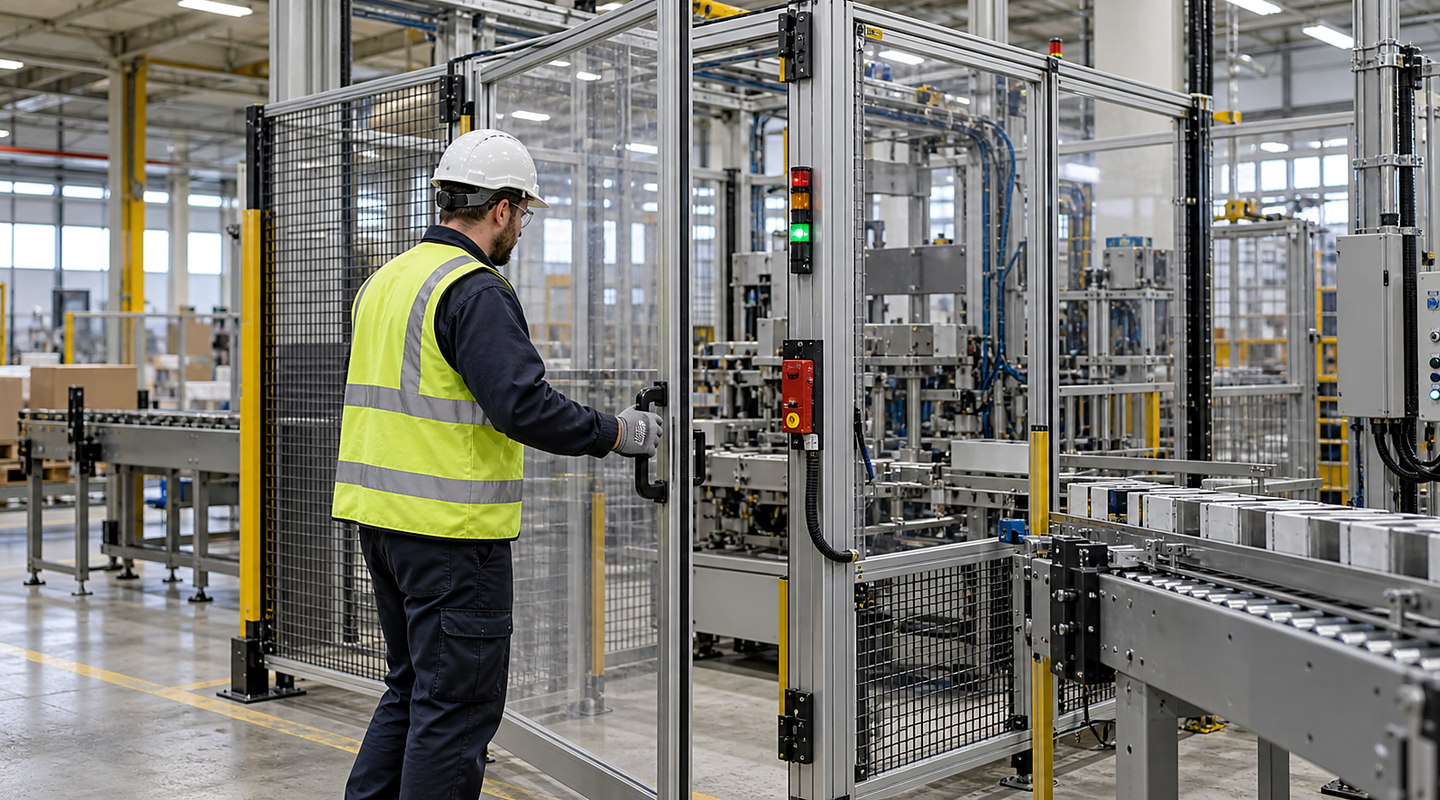
Safety Interlock Upgrades Selection Guide
Choose safety interlock upgrades by comparing your parts, process, rate, access, data needs and required results.
Choose safety interlock upgrades by how well each option handles your real variation, line connections, safe access, maintenance and required results—not headline speed alone.
For safeguarding existing machinery for existing machine interlock upgrades, a short trial that reproduces the difficult condition is often more useful than a long list of nominal specifications.
Compare options in the conditions where they must work — Safety Interlock Upgrades
Plan safety interlock upgrades around your machine hazards, operator tasks, access, stopping behaviour and validation evidence. Discuss a site-specific safeguarding concept with Oxford Machine Guarding. A useful shortlist should show how every option copes with hazards and foreseeable access for existing machine interlock upgrades and space, visibility and operator ergonomics.
Discuss your application
Ask every supplier the same questions
| Decision | What to ask | What to check |
|---|---|---|
| Hazards and Foreseeable Access for Existing Machine Interlock Upgrades | What normal range, extreme and rate of change applies to hazards and foreseeable access for existing machine interlock upgrades? | Representative samples and a controlled trial. |
| Machine Motion and Stopping Behaviour | What normal range, extreme and rate of change applies to machine motion and stopping behaviour? | Representative samples and a controlled trial. |
| Operating, Cleaning and Maintenance Tasks | What normal range, extreme and rate of change applies to operating, cleaning and maintenance tasks? | Drawings, observation and interface measurements. |
| Existing Control-System Architecture | What normal range, extreme and rate of change applies to existing control-system architecture? | Drawings, observation and interface measurements. |
| Space, Visibility and Operator Ergonomics | What normal range, extreme and rate of change applies to space, visibility and operator ergonomics? | Agreed operating and acceptance records. |
| Risk-Reduction and Validation Evidence | What normal range, extreme and rate of change applies to risk-reduction and validation evidence? | Agreed operating and acceptance records. |
Include simpler approaches to existing machine interlock upgrades in your shortlist
| Approach | Often suitable when | Watch for |
|---|---|---|
| Safety Interlock Upgrades | You need a dedicated solution for a clearly defined duty, product or part range and line interface. | Current standards and required performance levels must be assessed for the complete machine and intended use. |
| Fixed Physical Guarding where Access Is Rare | Your volumes, product mix or operator judgement make a simpler route more practical. | Check ergonomics, consistency and safe access before choosing the lower-complexity option. |
| Interlocked or Presence-Sensing Protection where Frequent Intervention Is Foreseeable | Your surrounding process is stable enough for a broader automated solution to add value. | Allow for line connections, fault recovery and maintenance as well as the headline equipment. |
Pause before choosing when…
- Only perfect or hand-selected examples of safeguarding existing machinery for existing machine interlock upgrades are available.
- No one has defined how risk-reduction and validation evidence will be evaluated.
- The normal range for hazards and foreseeable access for existing machine interlock upgrades is described only as “usually fine” but has not been bounded.
- Your operator, cleaning, maintenance or recovery access has not been considered.
- Quoted performance depends on another machine or data source that is not included.